Development of Inclusive Schools
These are the resources found under this topic.
- Book: Creating Inclusive Schools-
The Work of the New York Higher Education Support Center for SystemsChange
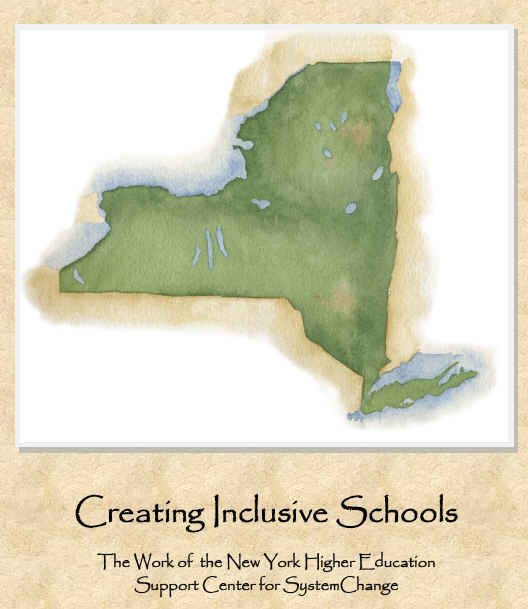
This book represents the final publication of the NY Higher Education Support Center for SystemsChange and is a chronical of the work performed by the HESC, and by the Task Force on Quality Inclusive Schooling.
Download this book (PDF)
- Book - Instructional Rounds Education- Instructional Rounds in Education A Network Approach to Improving Teaching and Learning Elizabeth A. City, Richard F. Elmore, Sarah E. Fiarman, and Lee Teitel, foreword by Andrew Lachman Instructional Rounds in Education is intended to help education leaders and practitioners develop a shared understanding of what high-quality instruction looks like and what schools and districts need to do to support it. paper, 230 Pages Pub. Date: Apr 2009 ISBN-13: 978-1-934742-16-7 cloth, 230 Pages Pub. Date: Apr 2009 ISBN-13: 978-1-934742-17-4
- IRIS Modules for - Visit the IRIS Center for Training Enhancements for free online interactive modules, podcasts, case studies and articles that directly and effectively translate research about the education of students with disabilities into practice. The materials of evidence-based topics, including behavior, RTI, learning strategies, and progress monitoring. Very effective modules that can be used directly with students in teacher preparation programs.
- Drawing Distinctions Between Coherent and Fragmented Efforts at Building Inclusive Schools- This discussion highlights the importance of making clear distinctions between the implementation of comprehensive and coherent inclusive practices and the inevitable problems or dilemmas that result from partial or fragmentary implementation. Practices that are seen in successful inclusive settings are discussed, as well as ideas concerning implications for future research and practice. Written by Linda Davern, The Sage Colleges, Education Dept., TroyMara Sapon-Shevin, Syracuse University Michaela D' Aquanni, Syracuse University Mary Fisher, Syracuse University
- Concerns-Based Adoption Model (CBAM): A Model for Change in Individuals- The concerns model identifies and provides ways to assess seven stages of concern. These stages have major implications for professional development. First, they point out the importance of attending to where people are and addressing the questions they are asking when they are asking them.
- New York State Staff Development Council- Their goal: Every educator engages in effective professional learning every day so every student achieves. They run an annual conference.
- Supporting Inclusive Classrooms: A Resource-
Edited by David J. Conner
Produced through the efforts of The New York City Task Force on Quality Inclusive Schooling
This book is available as a downloadable pdf document.
- Book: Because We Can Change the World- by Mara Sapon-Shevin ISBN 0205174892 With the increase of diverse students in all classrooms, pre-service and in-service teachers often find themselves overwhelmed with how to provide a quality learning community that is inclusive of all students. This book delivers hope, promise, and practical goals for teachers who wish to create a warm, respectful, and nurturing learning environment for their students, that will, in turn, inspire students to make a difference in their classroom community and the world beyond.
- A Process for Restructuring Service Delivery Models for Inclusion in New York State- This process for restructuring service delivery models for inclusion is based on a number of assumptions about educational restructuring efforts in general and inclusion in particular.
- JP Das Developmental Disabilities Centre- Developmental disabilities research and many resources for parents, students and educators.
- Easy School Search- Freely browsable database of over 130,000 US public and private elementary and secondary schools with grades kindergarten through twelve. The site lets you map schools by zipcode ,freetext searches, or simply browse by state,district or county. The data provided includes characteristics such as school size, school level, geographic region, community type, program emphasis, and other info.
- National Institute for Urban School Improvement - NIUSI- NIUSI hopes that its advocacy for inclusive urban schools (good for kids, families, and communities) engages professionals and laypeople alike in understanding the multifaceted cultures and histories that urban schools children and their families bring to the educational process.
- Urban Special Education Leadership Collaborative- The Urban Special Education Leadership Collaborative is a network of special and general education leaders working together to improve outcomes for students with disabilities in the nation's urban schools.
- National Inclusive Schools Week- The Week provides an important opportunity for educators, students, and parents to discuss what else needs to be done in order to ensure that their schools continue to improve their ability to successfully educate all children.
- Scoring Matrix for Program Quality Indicators Addressing the Needs of Students Through Inclusive Schools- The purpose of this matrix is to assess programs that seek to provide quality inclusive schooling to all students.
- New York State's Performance Plan- The SPP is designed to evaluate the State's efforts to implement the requirements and purposes of IDEA and describe how the State will improve results.
- Commissioner's Call to Action- Presents a communication plan; a structure for state, regional and local action; and guidance for both policy and practice in early education, high school, and higher education
- Applied Research Center- The Applied Research Center is a public policy, educational and research institute whose work emphasizes issues of race and social change.
- Rethinking Schools - Online Journal- Online Journal - Rethinking Schools emphasizes problems facing urban schools, particularly issues of race.